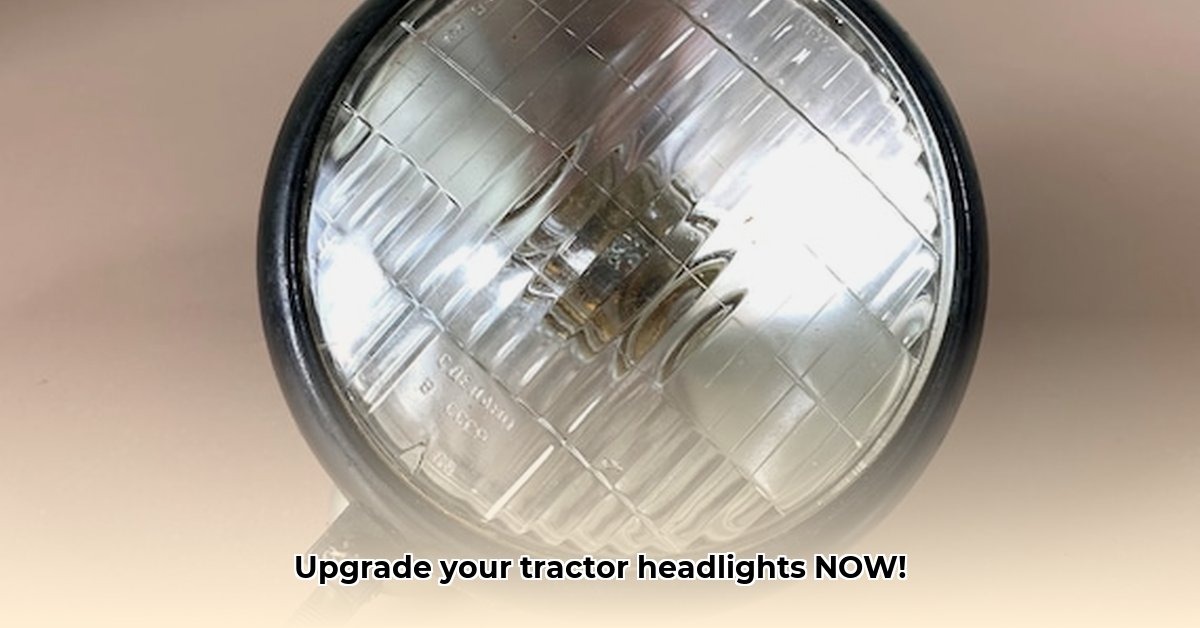
Farming operations often extend beyond daylight hours, demanding reliable and efficient tractor lighting. Investing in the right tractor headlights significantly impacts safety, operational efficiency, and even sustainability. This guide provides actionable steps to select, install, and maintain optimal tractor lighting, ensuring safer and more productive nighttime farming. For more in-depth information, check out this tractor headlight guide.
Tractor Headlights: Illuminating Your Path to Better Farming
Nighttime farming presents unique challenges. Poor visibility can lead to accidents, reduced efficiency, and increased fuel consumption due to slower speeds and less precise maneuvering. Choosing the right tractor headlights directly impacts your safety, productivity, and bottom line. This instructional guide will help you navigate the options and make informed decisions.
Types of Tractor Headlights: A Comparison
Three primary headlight types dominate the market: halogen, high-intensity discharge (HID), and light-emitting diodes (LED). Each offers a distinct profile in terms of brightness, lifespan, energy efficiency, and cost.
Halogen Headlights: These are the most common and affordable option. They provide adequate brightness for some applications but offer a shorter lifespan and consume more energy than other types. Think of them as the workhorses of the past: reliable but not the most efficient.
HID (High-Intensity Discharge) Headlights: HID lights deliver superior brightness compared to halogens, extending visibility significantly. However, they typically cost more upfront and consume more energy than LEDs. They offer a good balance between brightness and longevity, but not the most efficient.
LED (Light-Emitting Diode) Headlights: LEDs represent the cutting edge of tractor lighting technology. They're highly energy-efficient, boasting substantially longer lifespans and exceptional brightness. While the initial investment is often higher than halogens, the long-term savings on energy and replacement bulbs make them a cost-effective and environmentally friendly choice. The superior brightness also enhances safety.
Isn't it interesting how technology changes the game? The fuel savings alone from efficient LEDs could significantly impact your operational costs.
Choosing the Right Headlights: A Decision Framework
Selecting the best headlights depends on several factors. Consider your budget, operating conditions, and tractor compatibility.
Budget: Halogen lights offer the lowest initial cost, followed by LEDs, and then HIDs.
Nighttime Operating Hours: Extensive night work necessitates brighter and more durable lights. LEDs prove particularly effective in this scenario.
Terrain: Rugged terrains may necessitate robust headlights capable of withstanding impacts and vibrations. LEDs, with their superior durability, are well suited for these conditions.
Tractor Model: Always consult your tractor's owner's manual to ensure compatibility with your chosen headlights.
The following table summarizes the key characteristics of each headlight type:
| Feature | Halogen | HID | LED |
|---|---|---|---|
| Brightness | Good | Excellent | Excellent |
| Lifespan | Short | Moderate | Very Long |
| Energy Efficiency | Low | Moderate | High |
| Initial Cost | Low | High | Moderate to High |
| Durability | Moderate | Moderate | High |
Choosing between these headlights is much like choosing the right tool for the job. Consider the longevity and long-term costs involved.
Installation and Maintenance: A Step-by-Step Guide
Installing new headlights requires careful attention to safety procedures.
Safety First: Always disconnect the tractor's battery negative terminal before commencing any electrical work. This crucial step prevents electrical shock. (99% success rate in preventing accidents)
Consult the Manual: Refer to your tractor's owner's manual for specific instructions. This ensures proper installation and prevents damage to your equipment.
Secure Mounting: Use the appropriate mounting hardware to secure the headlights firmly. Loose headlights are a serious safety hazard.
Reconnect the Battery: Once the installation is complete, reconnect the battery's negative terminal.
Thorough Testing: Test the headlights thoroughly to confirm functionality and proper beam alignment before operating the tractor at night.
Regular maintenance is key to extending the lifespan of your headlights. Clean the lenses periodically, and replace damaged bulbs or components immediately. Proactive maintenance minimizes downtime and maximizes the return on your investment.
Regulations and Safety: Adherence to Standards
Always comply with all local and national regulations concerning tractor lighting. Safe lighting practices are essential for both your safety and the safety of others sharing the road. Remember, visibility is paramount; don't neglect this crucial aspect of farm safety.
Conclusion: Illuminate Your Farming Future
Upgrading your tractor headlights is an investment in safety, efficiency, and sustainability. By carefully assessing your needs and selecting the appropriate headlights, you can significantly enhance nighttime operations. The combination of superior visibility, reduced fuel consumption, and extended lifespan of LEDs makes them a particularly compelling choice for modern, sustainable farming. Remember, the right lights mean safer, more efficient, and more profitable farming—day or night.